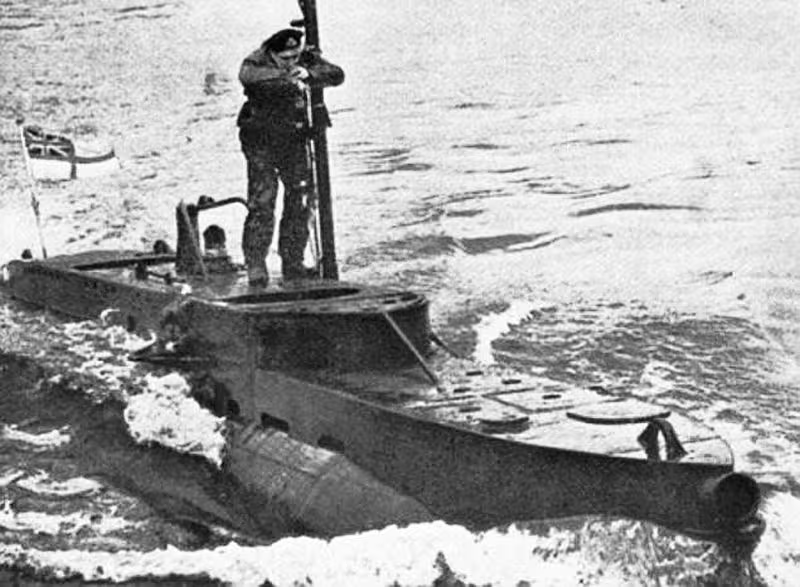
HMS X7 was one of the Royal Navy's famous X-class midget submarines (X-Craft) and played a crucial role in Operation Source, the daring September 1943 attack on the German battleship Tirpitz in northern Norway. The operation became one of the most celebrated special operations conducted by the Royal Navy during World War II.
Construction and Role
X7 was built as part of the X-class midget submarine programme, developed to attack heavily protected enemy warships in fjords and harbours. The craft was about 51 feet (15.6 m) long, carried a crew of four, and was armed with two large detachable explosive charges that could be placed beneath an enemy vessel.
For Operation Source, X7 was assigned to attack Tirpitz, Germany's most powerful battleship, anchored in Kåfjord, Norway. Tirpitz posed a major threat to Allied Arctic convoys supplying the Soviet Union.
Mission to Norway
In September 1943, X7 was towed across the North Sea by the submarine HMS Stubborn. Near the Norwegian coast, the operational crew transferred to the X-Craft and began the hazardous approach to Tirpitz's anchorage.
The commanding officer was Lieutenant Basil Charles Godfrey Place, RN. His crew included:
- Lieutenant Lionel "Buster" Whittam
- Sub-Lieutenant Robert Aitken (the diver)
- ERA William Whitley
Together they navigated through minefields, anti-submarine nets and strong harbour defences protecting Tirpitz.
Attack on Tirpitz
On 22 September 1943, X7 successfully penetrated the defensive barriers surrounding Tirpitz. Despite severe difficulties, Place manoeuvred the craft beneath the battleship and dropped its explosive side charges on the seabed below the target.
During the withdrawal, X7 was detected and came under attack. The submarine became damaged and eventually sank in the fjord, her charges remained in position beneath Tirpitz.
When the charges detonated, together with those laid by X6, they caused extensive damage to Tirpitz. The battleship was disabled and remained out of operational service for approximately six months, removing a major threat to Allied shipping.
Loss of X7
X7 was lost during the operation. Lieutenant Place escaped and was captured by the Germans. Sub-Lieutenant Aitken also survived and became a prisoner of war after escaping from the sunken craft. Lieutenant Whittam and ERA Whitley were unable to escape and died.
Awards and Legacy
For his outstanding leadership and bravery during the attack, Lieutenant Basil Place was awarded the Victoria Cross (VC), Britain's highest award for gallantry. Sub-Lieutenant Robert Aitken received the Distinguished Service Order (DSO).
Today, HMS X7 is remembered as one of the most successful X-Craft of the war. Her attack helped neutralise Tirpitz and demonstrated the effectiveness of midget submarines in special operations. The story of X7 and Operation Source was later popularised in the 1955 film "Above Us the Waves."
Key Facts
| Item | Details |
|---|---|
| Class | X-class midget submarine |
| Built | 1943 |
| Mission | Attack German battleship Tirpitz |
| Operation | Operation Source |
| Date of Attack | 22 September 1943 |
| Commanding Officer | Lt. Basil Place VC |
| Result | Charges successfully placed beneath Tirpitz |
| Fate | Lost during withdrawal from the attack |
| Significance | Helped disable Tirpitz for around six months |
X7 is widely regarded as one of the Royal Navy's most heroic small submarines, and Lieutenant Basil Place's exploit remains one of the classic Victoria Cross actions of the Second World War.