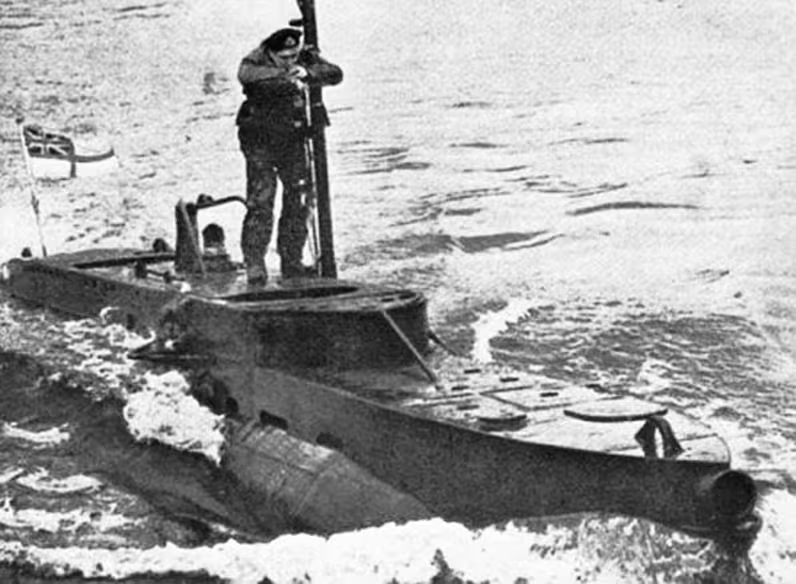
In December 1942, ship builders Vickers commenced building six midget submarines, called X-craft with the primary objective of putting Tirpitz out of action.
The X-craft were 16 metres long and 1.7 metres wide. They displaced 30 tons when submerged and were powered by a converted Gardner 4LK diesel engine, from a London bus. This charged a 30hp Blackman electric motor, giving a maximum speed of 6.5 knots on the surface and slightly less when submerged. The X craft had a crew of four, a captain, pilot, an engineer and a diver and carried two side cargoes of amatol, which could be set with a time fuse and detached prior to the boat getting clear of the subsequent explosion.
X6, commanded by Lt Donald Cameron also included Lt Lorimor, S/Lt Kendall and ERA Goddard as the crew. To allow the operational crew to rest, during the passage, Lt Wilson, in command and assisted by L/S McGregor and Stoker Oxley formed the passage crew.
X6 was towed across the North Sea in September 1943 by HMS Truculent before they transferred crews at the start of Operation Source, the operation to sink the Tirpitz. They had been briefed that Tirpitz lay far inland and at anchor in the KaaFjord which meant the five brave crews of X5, X6, X7, X8, & X10 had to navigate first through the Alten Fjord evading detection. X9 was sadly lost on passage when the tow line parted and bow heavy, she plunged into the depths.
The remaining submarines had to travel at least a thousand miles, negotiate minefields, dodge nets, gun defences and enemy listening posts. Having eluded all these hazards they finally placed the charges underneath the ship.
X5, commanded by Lieutenant Henty-Creer, disappeared with her crew during Operation Source. She is believed to have been sunk by a direct hit from one of Tirpitz's 105 mm guns before placing demolition charges. There was a possibility X5 had also successfully planted side charges before being destroyed, but this was never conclusively proven.
Lt Cameron in X6 lost his periscope and attacked blind. He was sighted, but was too close to the Tirpitz to be engaged by other than small arms. He laid his charges before scuttling his boat.
X7 also managed to drop their charges under Tirpitz, but were unable to escape and attacked. Both were abandoned and six crewmen captured. The crewman informed the German captain Hans Meyer that there would be explosions under Tirpitz within an hour. Meyer quickly attempted to move the ship away from the charges, but was unable to do so before the charges exploded.
Tirpitz was heavily damaged. She took on a lot of water and suffered mechanical damage. The first mine exploded abreast of turret Caesar, and the second mine detonated 45 to 55 m off the port bow. A fuel tank was ruptured, shell plating torn, a large indentation was made in the bottom of the ship, and bulkheads in the ship’s double-bottom buckled. Some 1,430 tons of water flooded the ship in fuel tanks and void spaces in the double bottom of the port side, which caused a list of two degrees, which was balanced by counter-flooding on the starboard side. The flood damaged all of the turbo-generators in No 2 generator room, and apart from one in No 1 generator room, all were disabled by broken steam lines or severed power cables. Turret Dora was thrown from its bearings and could not be rotated.
For this action, Donald Cameron (X6) and Basil Place (X7) were both awarded the Victoria Cross.