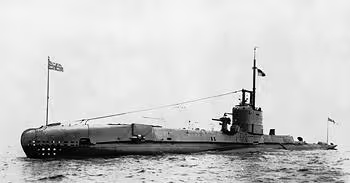
HMS Starfish was a first-group S-class submarine of the Royal Navy, built at Chatham Dockyard. She was ordered in March 1931, laid down on 29 September 1931, launched on 14 March 1933, and commissioned on 27 October 1933. She served throughout the pre-war years before entering combat during the opening months of the Second World War.
Design
Starfish was designed for operations in the confined waters of the North Sea and Baltic Sea. She displaced about 730 tons on the surface, carried a crew of 38, and was armed with six bow torpedo tubes and a 3-inch deck gun.
Early War Service
When war broke out in September 1939, HMS Starfish joined the 2nd Submarine Flotilla. Under the command of Lieutenant Thomas Anthony Turner, she conducted five patrols in the North Sea searching for German naval and merchant traffic. These patrols were largely uneventful, with no confirmed successes.
Final Patrol
On 5 January 1940, Starfish left Blyth for her sixth war patrol in the Heligoland Bight, one of the most heavily defended German naval areas.
On 9 January she sighted the German minesweeper M 7 and moved in to attack. Unfortunately, a serious drill error meant that her torpedoes failed to leave their tubes. After attempting to reposition for a second attack, her hydroplanes jammed, preventing normal diving control.
The German minesweeper detected the submarine and launched a series of depth-charge attacks. Throughout the day, repeated attacks caused severe flooding and structural damage. Water entered machinery spaces and the boat gradually became unmanageable.
Loss of the Submarine
By the evening, Lt Turner realized the submarine could no longer remain submerged. He ordered the crew to surface. To do so, Starfish had to jettison her ballast keel and use the last of her compressed air reserves. She surfaced at a steep angle while German vessels waited nearby.
German minesweepers opened fire and closed to the submarine. The crew abandoned ship and were rescued by the Germans. Shortly afterwards, HMS Starfish sank stern first in the Heligoland Bight on 9 January 1940. Remarkably, the entire crew survived and became prisoners of war.
Historical Significance
HMS Starfish is remembered because:
- She was one of the first Royal Navy submarines lost during the Second World War.
- Her loss resulted largely from mechanical failures and battle damage rather than a direct torpedo hit.
- Unlike many submarine losses, her entire crew survived the sinking.
- Her capture provided one of the earliest prisoner-of-war experiences for a complete British submarine crew during the war.
Key Facts
- Class: First-group S-class submarine
- Builder: Chatham Dockyard
- Commissioned: 27 October 1933
- Commanding Officer at loss: Lt Thomas Anthony Turner
- Lost: 9 January 1940 in the Heligoland Bight
- Cause: Depth-charge attack by German minesweeper M 7 after a failed torpedo attack
- Crew: All rescued and taken prisoner by Germany