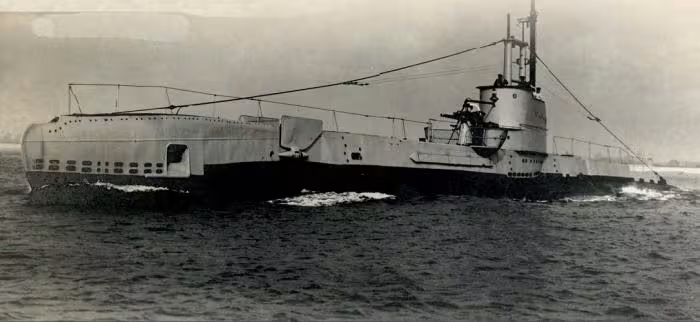
HMS Spearfish was a second-group S-class submarine of the Royal Navy, built by Cammell Laird at Birkenhead. She was launched on 21 April 1936 and commissioned on 11 December 1936.
Specifications
- Class: S-class submarine
- Pennant: N69
- Length: 208 ft 8 in (63.6 m)
- Surface displacement: 768 tons
- Crew: 40 officers and ratings
- Armament:
- 6 × 21-inch bow torpedo tubes
- 1 × 3-inch deck gun
Early War Service
On 24 September 1939, during her second war patrol off Horns Reef, Spearfish was heavily damaged by German warships. She could no longer dive but managed to escape and return to Britain. The Royal Navy mounted a substantial covering operation involving HMS Ark Royal, HMS Nelson, and other major units to protect her withdrawal to Rosyth.
Attack on Lützow
Spearfish achieved one of the Royal Navy submarine service's most notable early successes on 11 April 1940. Under the command of Lieutenant Commander John Hay Forbes, she torpedoed and severely damaged the German heavy cruiser Lützow (often referred to at the time as a pocket battleship) in the Kattegat. The damage kept Lützow out of action for over a year.
Loss
Spearfish sailed from Rosyth on 31 July 1940 for patrol duties off Norway. On 1 August 1940 she was sighted on the surface by the German submarine U-34, commanded by Wilhelm Rollmann. U-34 fired its last remaining torpedo, striking and sinking Spearfish about 130 nautical miles northeast of Aberdeen.
There was only one survivor, Able Seaman William V. Pester, who was rescued by U-34. The remainder of the crew were lost.
Historical Significance
Spearfish is remembered for:
- Surviving severe damage from German surface forces in September 1939.
- Torpedoing and crippling Lützow during the Norwegian campaign.
- Being sunk by U-34, one of the relatively few cases of a British submarine being destroyed by a German submarine during the war.