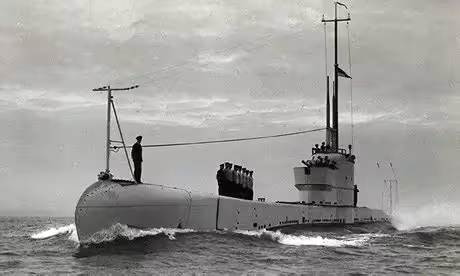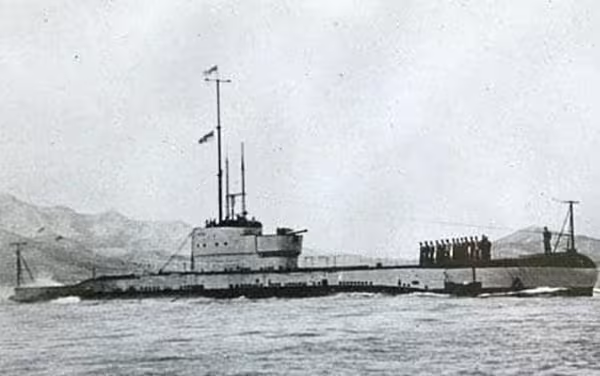
HMS Poseidon was a Parthian-class submarine of the Royal Navy, built by Vickers Shipbuilding and Engineering at Barrow-in-Furness. She was laid down on 5 September 1928, launched on 22 August 1929, and commissioned on 5 May 1930. Her pennant number was P99.
Service in China
After commissioning, Poseidon was assigned to the Royal Navy's China Station and operated from the naval base at Weihai on the coast of China. Most of her brief career was spent in the Yellow Sea, where British naval forces maintained a presence during the interwar period.
Collision and Sinking
On 9 June 1931, while conducting exercises on the surface about 20 miles north of Weihai, HMS Poseidon collided with the Chinese merchant ship SS Yuta. Conditions were reported to be clear, making the accident particularly shocking.
The submarine sank within minutes in approximately 130 feet (40 metres) of water. Thirty-one crew members escaped from the submarine before it sank, and substantial rescue efforts were launched involving the aircraft carrier HMS Hermes, the cruiser HMS Berwick, and the submarine HMS Perseus.
Famous Submarine Escape
The Poseidon disaster became historically important because several trapped sailors successfully escaped from the sunken submarine using the newly introduced Davis Submerged Escape Apparatus, a breathing device designed for underwater escape.
Eight crew members managed to leave the wreck underwater. Although not all survived the ascent, the success of several escapes demonstrated that submarine escape from depth was possible. In total, 21 crew members died in the disaster. [
The incident changed Royal Navy rescue doctrine. Previously, trapped crews were often advised to wait for rescue. Following the lessons of Poseidon, the Admiralty increasingly favoured immediate escape attempts when conditions allowed.
Secret Chinese Salvage
One of the most unusual aspects of the story occurred decades later.
In 1972, the wreck of HMS Poseidon was secretly raised by Chinese naval salvage teams. The operation was largely unknown outside China for many years and only became widely known in the West after researchers uncovered Chinese accounts of the recovery. The submarine was reportedly recovered as part of efforts by China to develop deep-water salvage techniques and underwater recovery capabilities. Questions remain about the fate of some human remains and artefacts recovered during the operation.
Historical Significance
HMS Poseidon is remembered for:
- One of the most famous submarine accidents of the interwar period.
- Demonstrating the effectiveness of the Davis Submerged Escape Apparatus.
- Influencing future Royal Navy submarine escape procedures.
- Being secretly salvaged by China over 40 years after sinking.
Key Facts
- Name: HMS Poseidon
- Pennant Number: P99
- Class: Parthian-class submarine
- Commissioned: 5 May 1930
- Lost: 9 June 1931 in collision with SS Yuta
- Fatalities: 21 crew members
- Location: Near Weihai, China, in the Yellow Sea
- Salvaged: Secretly by China in 1972
Unlike many Royal Navy submarines lost in wartime, HMS Poseidon was lost in peacetime, but her sinking had a lasting impact on submarine escape techniques used around the world.