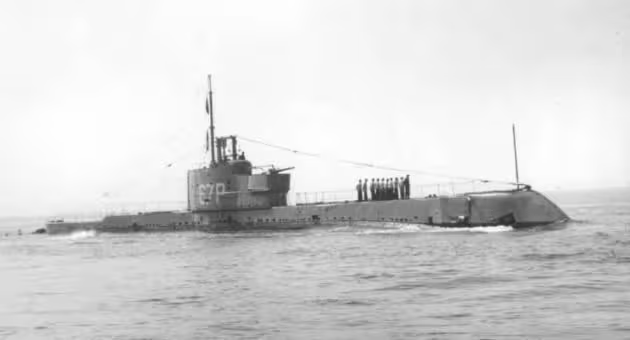
HMS Olympus was an Odin-class submarine of the Royal Navy, built by William Beardmore & Co. on the Clyde. She was launched on 11 December 1928 and commissioned on 14 June 1930. Originally designed for long-range patrols in the Pacific, she later served on the China Station before becoming heavily involved in Mediterranean operations during the Second World War.
Early Service
- Served with the 4th Submarine Flotilla on the China Station from 1931 to 1939.
- Joined the 8th Flotilla at Colombo, Ceylon (Sri Lanka) at the outbreak of war.
- Took part in operations against German commerce raiders, including pursuit of the Admiral Graf Spee in late 1939.
Mediterranean Service
Olympus was transferred to the Mediterranean in 1940. While in Malta dockyard on 7 July 1940 she was damaged during an Italian air raid and required extensive repairs.
As the siege of Malta intensified, submarines became vital to sustaining the island. Olympus was adapted to carry:
- Fuel
- Ammunition
- Supplies
- Personnel
These dangerous transport missions became known as the "Magic Carpet Service."
One recorded combat action occurred on 9 November 1941 when she attacked the Italian merchant vessel Mauro Croce in the Gulf of Genoa, though the target escaped.
Final Voyage
By May 1942 Malta was under intense Axis attack. Olympus was ordered to evacuate many of their surviving crews from Malta.
On 8 May 1942, Olympus departed Malta bound for Gibraltar carrying:
- Her own crew
- Survivors from other submarines
- A total of 98 men aboard
Only a few miles from Valletta, she struck an Axis mine in position approximately 35°55'N, 14°35'E. The explosion caused catastrophic flooding and knocked out communications. Despite efforts to signal for help, the submarine sank within minutes.
Casualties and Survival
The survivors escaped from the sinking submarine and faced a brutal 7 mile swim back to Malta.
- 98 aboard
- 89 lost
- 9 survived
This was one of the worst British submarine disasters of the war. Some historians have described it as the single largest loss of life in a Royal Navy submarine sinking during World War II.
Discovery of the Wreck
The wreck was located off Malta and positively identified in 2011 after sonar surveys and remotely operated vehicle (ROV) inspections. She lies:
- Upright on the seabed
- About 115 metres (377 feet) deep
- Approximately 7 miles off Valletta
Investigations showed heavy damage on the starboard side consistent with a mine explosion. The wreck is now regarded as a protected war grave.
Summary
| Item | Detail |
|---|---|
| Class | Odin-class submarine |
| Pennant | N35 |
| Commissioned | 14 June 1930 |
| Lost | 8 May 1942 |
| Cause | Mine strike off Malta |
| Position | Approx. 35°55'N, 14°35'E |
| Persons aboard | 98 |
| Survivors | 9 |
| Fatalities | 89 |
Olympus is remembered not only as a frontline submarine but also as one of the vessels that kept Malta alive during its darkest period. Her final loss, carrying fellow submariners to safety, remains one of the most poignant tragedies in Royal Navy submarine history