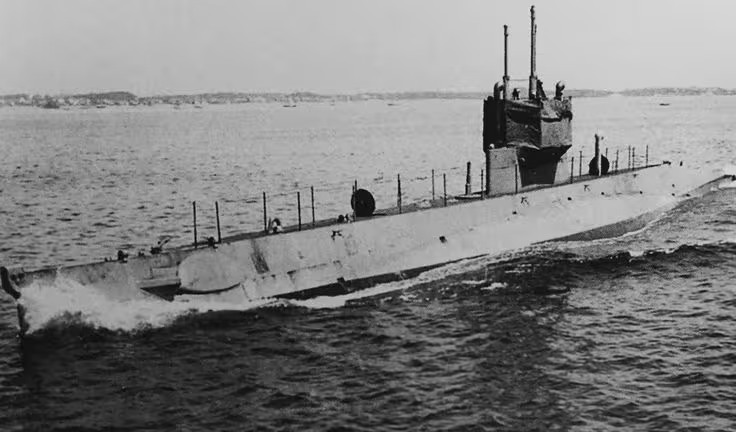
HMS L10 was an L-class submarine of the Royal Navy built by William Denny and Brothers at Dumbarton, Scotland. She was launched on 24 January 1918 and commissioned in June 1918, entering service during the final months of the First World War.
Design
L10 was one of the improved L-class submarines, designed for North Sea operations against German warships and minelayers. She displaced 914 tons surfaced and 1,089 tons submerged, carried a crew of 38, and was armed with:
- Four 21-inch bow torpedo tubes
- Two 18-inch beam torpedo tubes
- One 4-inch deck gun
She could make 17 knots on the surface and 10.5 knots submerged.
Operational Service
After commissioning, L10 was assigned to operations in the North Sea, where British submarines patrolled against German surface forces attempting to lay mines and threaten Allied shipping.
Although her service life lasted only a few months, she became involved in one of the most dramatic submarine engagements of the war.
Final Action in the Heligoland Bight
On 3 October 1918, under the command of Lieutenant Commander Alfred Edward Whitehouse, L10 was operating in the Heligoland Bight. There she encountered a group of German torpedo boats that had been delayed after S34 struck a mine. Nearby were S33, V28, and other escorting vessels.
Taking advantage of the confusion, Whitehouse manoeuvred into attack position and fired a torpedo at S33. The attack was successful and seriously damaged the German vessel. Some accounts describe S33 as beginning to sink, while others state she was crippled and later had to be scuttled.
However, the success came at a terrible cost.
As L10 fired, she unexpectedly broached or surfaced, revealing her position to the German escorting torpedo boats. V28 and her companions immediately opened fire and pursued the submarine. L10 was unable to escape and was sunk with the loss of all hands.
Loss of the Crew
The entire ship's company of 39 perished in the sinking, including Lieutenant Commander A. E. Whitehouse.
Historical Significance
L10's final patrol is often described as a Pyrrhic victory. She successfully attacked an enemy warship but was destroyed as a direct consequence of the attack.
She is also notable for being:
- The only L-class submarine lost during the First World War.
- One of the Royal Navy's last submarine losses before the Armistice of November 1918.
- Lost after only about four months in commission.
Key Facts
- Name: HMS L10
- Class: L-class submarine
- Builder: William Denny and Brothers, Dumbarton
- Commissioned: June 1918
- Commanding Officer: Lt Cdr Alfred Edward Whitehouse
- Lost: 3 October 1918 in the Heligoland Bight
- Cause: Sunk by German torpedo boats after attacking S33
- Crew lost: 39 men, all hands
- Notable distinction: Only L-class submarine lost in World War I.