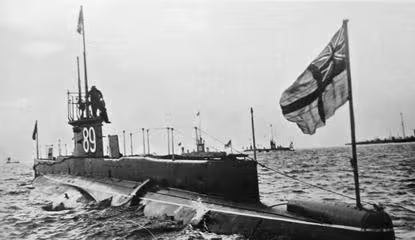
HMS E9 was one of the most famous British submarines of the First World War. Built by Vickers at Barrow-in-Furness, she was commissioned on 16 June 1914, just before the outbreak of war, and became renowned under the command of Lieutenant Commander Max Kennedy Horton, later a distinguished Royal Navy admiral.os
Specifications
- Class: E-class submarine
- Length: 181 ft (55 m)
- Displacement: 667 tons surfaced, 807 tons submerged
- Armament: Five 18-inch torpedo tubes carrying up to ten torpedoes, plus a 2-pounder gun later in her career.
- Crew: 31 officers and ratings.
Early War Successes
On 13 September 1914, E9 achieved the first major combat success by a British submarine when she torpedoed and sank the German light cruiser SMS Hela near Heligoland. Despite an intensive German search, E9 escaped safely back to Britain.
Just weeks later, on 6 October 1914, E9 sank the German destroyer S116, earning Max Horton the Distinguished Service Order (DSO).
Origin of the Jolly Roger Tradition
E9 is particularly famous because her commander, Max Horton, started the Royal Navy submarine tradition of flying the Jolly Roger pirate flag after a successful patrol. After returning from the sinking of SMS Hela, Horton flew a Jolly Roger as a response to critics who had described submarines as "piratical" weapons. That tradition continues in the Royal Navy submarine service today.
Baltic Campaign
In October 1914, E9 and HMS E1 successfully penetrated German-controlled waters and entered the Baltic Sea, beginning the highly successful British Baltic submarine campaign.
During Baltic operations, E9:
- Damaged the German armoured cruiser Prinz Adalbert on 2 July 1915.
- Sank the German cruiser Bremen on 17 December 1915.
- Sank the German torpedo boat V191 during the same action.
- Sank or captured several German merchant vessels and colliers, disrupting German maritime supply routes.
For his Baltic successes, Max Horton received several Russian decorations, including the Order of St. George.
Fate
Like HMS E1, HMS E8, HMS E19, HMS C26, HMS C27, and HMS C35, E9 was scuttled near Helsingfors (Helsinki) in April 1918 to prevent capture by advancing German forces following Russia's withdrawal from the war.
HMS E9 is often regarded as the most famous British submarine of the Baltic campaign, largely because of Max Horton's exploits and the birth of the Jolly Roger tradition.