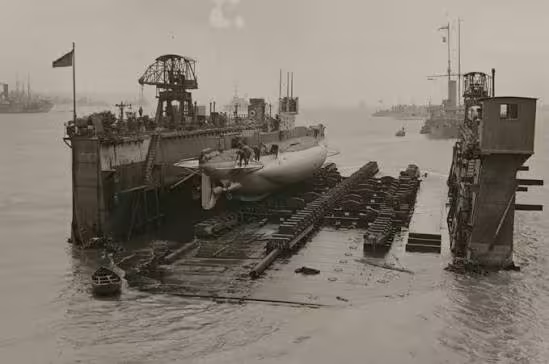
HMS E47 was a British E-class submarine of the Royal Navy during the First World War. She was built by William Beardmore at Dalmuir, launched on 29 May 1916, and commissioned in October 1916.
- Class: E-class submarine
- Displacement: 662 tons surfaced; 807 tons submerged
- Length: 181 ft (55 m)
- Speed: 15 knots surfaced; 10 knots submerged
- Range: 3,000 nautical miles at 10 knots surfaced
- Complement: 31 officers and men
- Armament:
- Five 18-inch torpedo tubes (two bow, two beam, one stern)
- One 12-pounder deck gun
- Ten torpedoes carried
Service
HMS E47 served with the 9th Submarine Flotilla based at Harwich, operating in the North Sea against German naval forces and merchant traffic. She conducted patrols off the German and Dutch coasts, a dangerous area heavily defended by mines and patrol vessels.
Loss
On 20 August 1917, HMS E47, commanded by Lieutenant Edward C. Carré, sailed from Harwich to patrol near the Dutch coast around the Texel Islands. She failed to return and was officially declared lost with all hands. There were no survivors.
For many years her fate remained unknown. In 2012, Dutch divers examined a wreck northwest of Texel and identified it as HMS E47 after recovering and identifying the detached deck gun. Evidence from the wreck, including a large hole beneath the bridge area, suggests she was probably sunk by a mine.
Notable Casualty
Among the 32 men lost was Lieutenant Colin Fraser Creswell, son of Vice Admiral Sir William Rooke Creswell, a prominent figure in the development of the Royal Australian Navy.
Historical Note
The discovery and identification of HMS E47's wreck helped solve a century-old mystery and provided evidence that she most likely fell victim to one of the many minefields that made the North Sea one of the most hazardous naval theatres of the First World War.