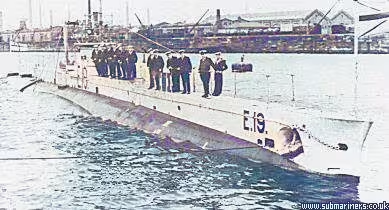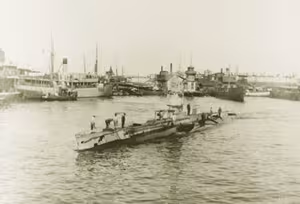
HMS E19 was one of the most successful British submarines of the First World War's Baltic campaign. Built by Vickers at Barrow-in-Furness, she was laid down on 27 November 1914, launched on 13 May 1915, and commissioned on 12 July 1915.
Specifications
- Class: E-class submarine (E2 group)
- Displacement: 662 tons surfaced; 807 tons submerged
- Length: 54.86 m (180 ft)
- Speed: 15.25 knots surfaced; 9.75 knots submerged
- Crew: 3 officers and 28 ratings
- Armament: Five 18-inch torpedo tubes carrying 10 torpedoes, plus a 2‑pounder deck gun.
Commander
E19 is closely associated with Lieutenant Commander Francis Newton Cromie, one of the outstanding submarine officers of the war. Under his command, E19 became a major threat to German shipping in the Baltic.
Baltic Operations
In September 1915, E19 successfully passed through the Danish straits into the Baltic Sea, becoming the last of five British E-class submarines to reinforce the British Baltic Flotilla.
The flotilla's mission was to disrupt German maritime trade, particularly iron ore shipments from Sweden to Germany. E19 proved exceptionally effective at this task.
The Öland Convoy Attack
On 11 October 1915, south of Öland, E19 intercepted German merchant shipping and sank four German freighters within a few hours. Cromie first gave crews time to abandon ship before sinking the vessels, meaning there were no casualties. This action shocked German shipping interests and demonstrated the vulnerability of Baltic trade routes.
Sinking of SMS Undine
On 7 November 1915, E19 torpedoed and sank the German light cruiser SMS Undine in the Baltic Sea. This was one of the most significant submarine victories in the theatre and further increased German caution in Baltic naval operations.
Strategic Impact
Together with HMS E1, HMS E8, and HMS E9, E19 helped make the Baltic increasingly dangerous for German naval and commercial traffic. The British submarine flotilla forced Germany to divert resources and limited German freedom of movement at sea.
Fate
Following the Russian collapse and the German advance into Finland in 1918, E19 could not be evacuated. She was deliberately scuttled near Helsinki (Helsingfors) on 8 April 1918 to prevent capture. She was sunk alongside E1, E8, E9, C26, C27, and C35.