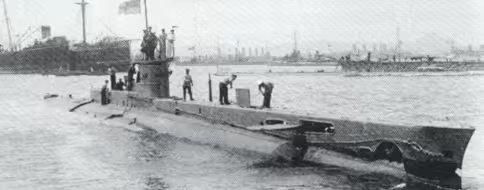
HMS E15 was an E-class submarine of the Royal Navy, commissioned on 29th April 1914.
E15 had a displacement of 662 tons at the surface and 807 tons while submerged. She had a total length of 180 feet and a beam of 22 feet 6 inches. She was powered by two 800 Hp Vickers eight-cylinder two-stroke diesel engines and two 420 Hp electric motors. The submarine had a maximum surface speed of 16 knots and a submerged speed of 10 knots. British E-class submarines had a range of 3,255 miles when travelling at 10 knots and was capable of operating submerged for five hours when travelling at 5 knots . Her complement was three officers and 28 men.
As with most of the early E-class boats, E15 was not fitted with a deck gun during construction but, later had a 12-pounder Quick-Firing gun fitted, forward of the conning tower. She had five 18-inch torpedo tubes, two in the bow, one either side amidships, and one in the stern; carrying a total of 10 torpedoes.
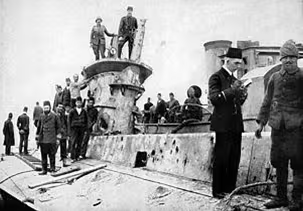
During the First World War, HMS E15 served in the Mediterranean, participating in the Gallipoli Campaign against the Ottoman Empire. On 16 April 1915, under the command of Lt Cdr Theodore S. Brodie, E15 sailed from her base at Mudros and attempted to break through the Dardanelles into the Sea of Marmara. Early on the morning of 17 April, the submarine, having dived too deep and caught in the vicious current, ran aground some ten miles in, near Kephez Point, directly under the guns of Fort Dardanos. E15 was soon hit and disabled; Brodie was killed in the conning tower by shrapnel and six of the crew were overcome by chlorine gas, released when the submarine’s batteries were exposed to seawater after a second shell strike.
Forced to abandon ship, the remaining crew surrendered, to be incarcerated in a prisoner of war camp near Istanbul where six later died.
Fearing that the wreck of HMS E15 might fall into the hands of the Turks, several attempts were made to destroy her. First, the British submarine B6, with Brodie's brother on board, tried to sink her by torpedo but missed. Later, during the night, the destroyers HMS Grampus and Scorpion, attempted to find her, but failed. The following morning, B11 also failed to locate E15 owing to dense fog. Then the battleships Triumph and Majestic were ordered in but, prevented by intense fire from the Turkish shore batteries from getting within 11,000 metres of the submarine, were obliged to withdraw. Meanwhile, seaplanes attempted to bomb the stricken E15 but also failed.
Finally, on the night of 18 April, two 56 ft picket boats, one from Triumph, the other from Majestic, both armed with two 14-inch diameter torpedoes mounted in dropping gear, went in. Lt Cdr Eric Robinson, a volunteer from Vengeance, commanded the expedition from Triumph's boat; whilst Lt Godwin skippered the boat from Majestic. Setting off at 22:00, the two vessels managed to navigate the narrow channel for seven miles, under fire from both shores, miraculously remaining unscathed.
Locating the stricken E15, Godwin managed to successfully torpedo HMS E15 forward of the conning tower, but below the waterline, but in doing so, Majestic’s Picket boat was also hit by the Turkish guns, blowing the stern away. The survivors were subsequently rescued by HMS Triumph’s picket boat and managed to escape downstream.
HMS E15 remains off Kephez Point in 26ft of water.