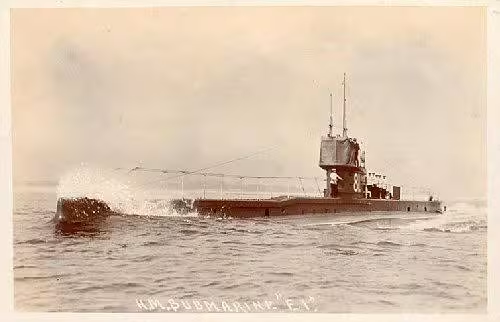
HMS E1 was the first boat of the Royal Navy's highly successful E-class submarine design. Originally laid down as HMS D9, she was redesignated E1 during construction and built at HM Dockyard, Chatham. She was laid down on 14 February 1911, launched on 9 November 1912, and commissioned on 6 May 1913.
Specifications
- Class: E-class submarine
- Displacement: 652 tons surfaced; 795 tons submerged
- Length: 178 ft (54 m)
- Speed: 15 knots surfaced; 9.5 knots submerged
- Crew: 30 men, including 3 officers
- Armament: 4 × 18-inch torpedo tubes (1 bow, 2 beam, 1 stern)
Baltic Operations
HMS E1 was one of the pioneering British submarines sent into the Baltic Sea during the First World War. In October 1914, under Lieutenant Commander Noel Laurence, E1 and HMS E9 successfully penetrated German-controlled waters and entered the Baltic, establishing the British submarine campaign there.
On 18 October 1914, E1 attempted to attack the German armoured cruiser SMS Victoria Louise in Kiel Bay, but the torpedo ran too deep and missed.
Most Famous Action
On 19 August 1915, during the Battle of the Gulf of Riga, E1 torpedoed and seriously damaged the German battlecruiser SMS Moltke (about 23,000 tons). The attack contributed to the German decision to curtail operations in the Gulf of Riga.
The achievement was considered so important that Tsar Nicholas II reportedly told Commander Laurence:"You have saved our town of Riga."
E1 also sank the German auxiliary minesweeper Aachen on 30 July 1915 near Gotland.
Fate
Following the collapse of Russia and the advance of German forces into Finland, E1 and the remaining British Baltic submarines could not be evacuated. On 3 April 1918, E1 was deliberately scuttled near Helsinki (then Helsingfors) to prevent capture. She was sunk alongside E8, E9, E19, C26, C27, and C35