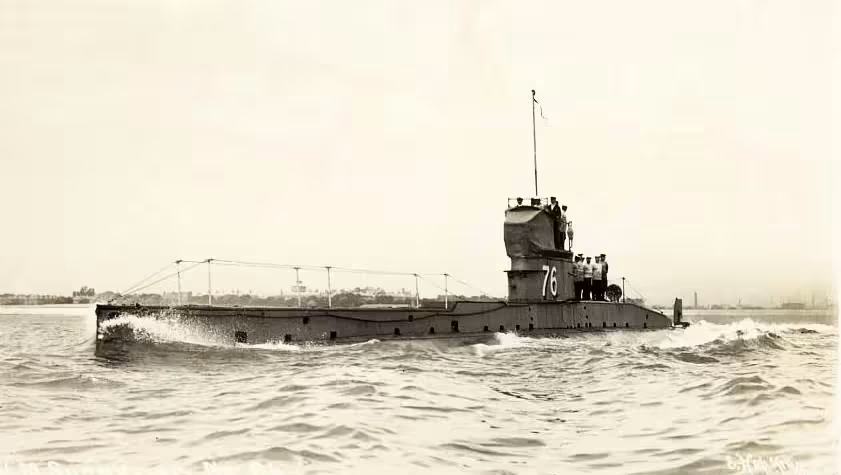
HMS D6 was a D-class submarine of the Royal Navy, built by Vickers Armstrong at Barrow-in-Furness. She was laid down on 24 February 1910, launched on 23 October 1911, and commissioned on 19 April 1912.
The D-class marked a major step forward in British submarine design, introducing diesel engines, improved endurance, wireless communication, and greater seaworthiness than earlier classes.
Design
D6 displaced about 483 tons surfaced and 595 tons submerged, carried a crew of 25, and was armed with three 18-inch torpedo tubes and a 12-pounder deck gun.
She was historically significant because she was the first British submarine completed with a deck gun fitted as built, a feature that would become standard on later submarines.
The D-class was also the first Royal Navy submarine class to use diesel engines instead of the more hazardous petrol engines found in earlier boats.
First World War Service
During the First World War, D6 served principally in the North Sea and the approaches to the English Channel, where British submarines sought to intercept German warships and U-boats.
A notable success came on 12 May 1918 when, under the command of Lieutenant C. B. Barry, D6 detected and attacked a German U-boat believed to be preparing an attack on a troop convoy. The attack was successful and Barry received the Distinguished Service Order (DSO).
Sources differ on the identification of the U-boat involved. The Submarine Book of Remembrance records the action as a successful attack on a German U-boat, while some naval records identify the victim as UB-72.
Loss
On 24 June 1918, while under the command of Lieutenant S. A. Brooks, D6 was operating off the west coast of Ireland. She was torpedoed by the German submarine UB-73, commanded by Kapitänleutnant Otto Neureuther.
The attack occurred north of Inishtrahull Island. D6 sank rapidly. Only two men, including the commanding officer and second-in-command F. S. Bell, survived and were taken prisoner by UB-73. The remainder of the crew were lost.
F. S. Bell later went on to command HMS Exeter during the Battle of the River Plate in 1939.
Historical Significance
HMS D6 is notable for several reasons:
- She was the first British submarine fitted with a deck gun from new.
- She belonged to the pioneering D-class, Britain's first submarines capable of extended offshore operations.
- Her destruction by UB-73 made her one of the relatively few submarines sunk by another submarine during the First World War.
- Contemporary reports described her as the first submarine to both sink and be sunk by another submarine during the war.
Key Facts
- Name: HMS D6
- Class: D-class submarine
- Builder: Vickers Armstrong, Barrow-in-Furness
- Commissioned: 19 April 1912
- Crew: 25
- Major success: Sank a German U-boat in May 1918.
- Lost: 24 June 1918 off the Irish coast.
- Cause: Torpedoed by German submarine UB-73.
- Survivors: 2, both taken prisoner.
- Fatalities: 23 crew members lost.
HMS D6 represents an important transitional stage in submarine development and had a distinguished wartime record before her loss off Ireland in the final months of the First World War.