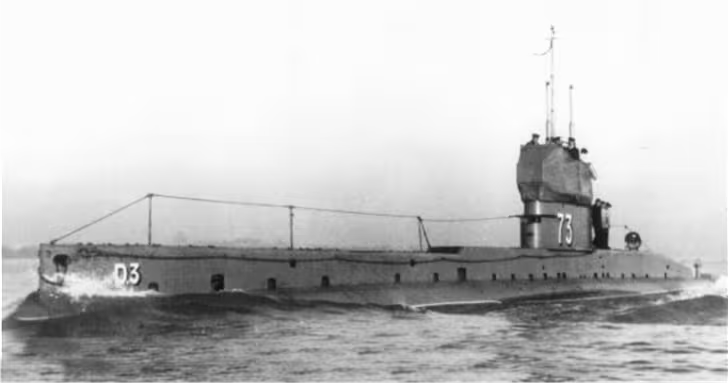
The D-class submarines were designed as an improved and enlarged version of the preceding C class.
Diesel engines were introduced to replace the more dangerous petrol engines used in the C-class. D3 and subsequent boats were slightly larger than the earlier boats. They had a length of 164’, a beam of 20’ 5” and a draught of 11’ 5”. Surfaced they displaced 503 tons and 630 tons submerged. The D-class submarines were crewed by 3 officers and 24 other ranks and were the first to adopt saddle tanks into their design.
For surface running, the boats were powered by two 600 horsepower (447 Kw) diesels, each driving one propeller shaft. When submerged each propeller was driven by a 275 horsepower (205 kW) electric motor. They could reach 14 knots on the surface and 9 knots submerged. On the surface, the D-class had a range of 2,500 nautical miles at 10 knots. The boats were armed with three 18-inch torpedo tubes, two in the bow and one in the stern. They carried one reload for each tube, a total of six torpedoes.
She was built by Vickers Ship Builders in Barrow and launched on 17th October 1910
Towards the end of the First World War, HMS D3 left Gosport on Thursday 7th March 1918 for an anti-submarine patrol in the English Channel. Little is known of her patrol movements but it is believed that a submarine spotted by a Royal Naval Air Service airship on the 11th was HMS D3.
The French airship AT-0, piloted by the Ensign of Saint-Rémy, took off from Le Havre in foggy weather and climbed to 1600 feet. Around 2:20 pm, patrolling in the English Channel off Fécamp, a boat was spotted in the north-east sector; the airship crew could not identify her, so he set course for it. As the airship approached, the crew could see identification marks and as it passed above, D3 fired rockets. The commander of the airship, assuming that this was an aggressive action, ordered his radio operator to open fire with the machine gun, convinced that he had a U-boat beneath him. The bullets could be seen ricocheting off the hull of the submarine, which immediately began to dive. The crew then began bombing with F-type bombs each weighing 52kg designed to explode at 8 meters. The first two bombs dropped missed their target by 20m. During the second pass, four new bombs were launched, two of which hit the submarine. As the airship moved away, the submarine HMS D3 was seen partially submerged, before disappearing beneath the sea. When the airship returned to the position, there were three or four men in the sea. Attempts were made by the airship to rescue the men but it proved too difficult. The airship withdrew to seek help but all the men had drowned by the time help arrived. It is clear that Submarine D3 was the victim of an identification error on the part of the French airship, with identification rockets being mistaken for aggressive gunfire.
Three officers and twenty-four men lost their lives that day. In 2006, a team of English divers located the wreck but refused to reveal the exact location of the submarine.