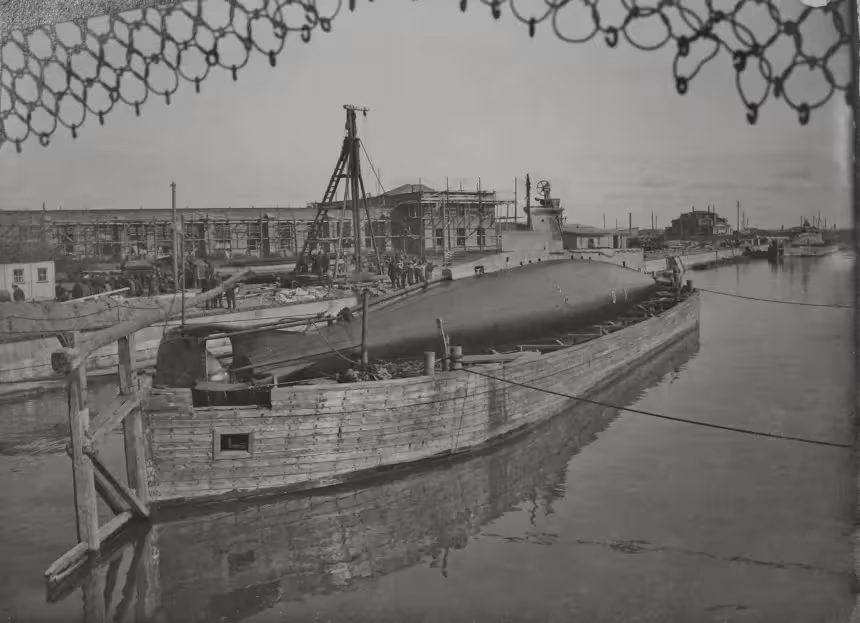
HMS C27 was a C-class submarine of the Royal Navy, built by Vickers at Barrow-in-Furness. She was laid down on 4 June 1908, launched on 22 April 1909, and commissioned on 14 August 1909.
Although a relatively small submarine, C27 achieved one of the Royal Navy's earliest anti-submarine successes and later served in the hazardous Baltic campaign of the First World War.
Design
C27 belonged to the improved later group of C-class submarines. She displaced about 290 tons surfaced and 320 tons submerged, carried a crew of 16, and was armed with two 18-inch bow torpedo tubes.
Powered by a petrol engine on the surface and an electric motor underwater, she could reach 13 knots surfaced and 8 knots submerged
Sinking of U-23
C27's most famous achievement came on 20 July 1915 in the Fair Isle Channel between Orkney and Shetland. Working with the trawler Princess Louise (formerly Princess Marie Jose), she took part in an experimental "U-boat trap" operation.
The tactic involved a trawler towing a submerged submarine while maintaining communication by telephone cable. When a German U-boat approached the apparently harmless fishing vessel, the submarine would be released from tow and attack.
This tactic worked successfully when C27 attacked and sank the German submarine U-23. It was one of the earliest successful British anti-submarine ambushes of the war.
The method was later abandoned after the loss of other C-class submarines employing the same technique.
Baltic Service
Later in 1915, C27 was selected for the Royal Navy's secret Baltic campaign. Along with three other C-class boats, she was transported by an extraordinary route around the North Cape to Arkhangelsk and then onward to the Baltic to reinforce British E-class submarines already operating there.
Operating from bases at Reval (modern Tallinn) and later Helsingfors (Helsinki), C27 participated in Allied efforts to disrupt German naval activity and the transport of Swedish iron ore to Germany.
Scuttling in 1918
By early 1918, following the Russian Revolution and the German advance into Finland, the British Baltic Flotilla faced capture. To prevent the submarines falling into German hands, orders were given to destroy them.
On 5 April 1918, C27 was deliberately scuttled south of the Harmaja Light outside Helsingfors. The care-and-maintenance party under Lieutenant Downie destroyed stores and torpedoes before evacuating safely via Petrograd and Archangel.
Final Fate
The wreck remained in the Baltic for decades. It was eventually salvaged and broken up in August 1953.
Key Facts
- Name: HMS C27
- Class: C-class submarine
- Builder: Vickers, Barrow-in-Furness
- Commissioned: 14 August 1909
- Famous success: Sank German submarine U-23 on 20 July 1915.
- Theatre of operations: North Sea and later the Baltic Sea.
- Scuttled: 5 April 1918 outside Helsingfors to avoid capture.
- Final disposal: Salvaged and scrapped in August 1953.
HMS C27 is particularly notable for her role in sinking U-23 using the innovative "U-boat trap" tactic and for her service in the Royal Navy's little-known Baltic submarine campaign during the First World War.