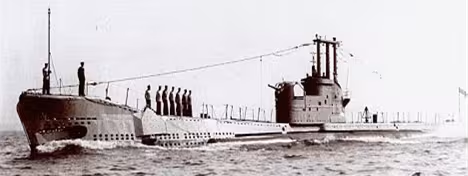
HMS Affray was built in Birkenhead and launched on 12th April 1945 and was a state-of-the-art submarine at the time of her launch. Some elements of her design were taken from captured Nazi German U-boats. Her modular style of manufacture and all-welded hull were unique at the time. For work in the Far East she was equipped with refrigeration and air conditioners, and all her accommodation was placed as far away from the engine room as possible. She also had ten torpedo tubes which made her one of the most formidable submarines in the world at that time.
In March 1949 she was fitted with Snort Mast - a steel tube which, when in the vertical position, worked as a snorkel. Once vertical it drew air into the submarine permitting it to run diesels to charge the batteries for propulsion whilst submerged.
In March 1951, following a period in reserve, Lieutenant John Blackburn DSC was appointed CO and given the task of bringing her and the new crew up to full operational status.
On 16 April 1951, HMS Affray set out on a simulated war mission called Exercise Spring Train which was expected to continue until she returned to Portsmouth on the 23rd April for repairs. Affray left her Portsmouth at about 1600 hrs, and 5 hours later made normal contact to confirm position, course and speed, indicating she was preparing to dive.
The last ship to see Affray was the destroyer HMS Contest returning to Portsmouth that evening. As they passed each other, both piped the side. When she missed her 0800 report the following day she was declared missing.
On 14 June the search vessel HMS Loch Insh made a sonar contact on the edge of Hurds Deep. HMS Reclaim arrived several hours later. A diver was then sent down to the contact and reported seeing a long white handrail before being dragged along with the flow of the current. Due to bad weather the crew decided to use the underwater camera which recorded the letters "YARFFA"—Affray backwards. She had been found. Affray foundered 17 miles northwest of Alderney, a lot closer to France than England. She lay slightly to port facing northeast in 280 feet of water, and during the next few months she slid a little more to port where she appears to have come to rest on a roughly 50 degree angle. It was noted that the periscope and radar mast were still extended, indicating she had been at periscope depth when she foundered. Divers could find no evidence of collision or damage to the hull, casing or bridge, however the snort mast had been broken and lay next to the wreck, attached by only a thin shred of metal. The hatches and torpedo tubes were all shut, and the two emergency buoys were still located within the casing. It became obvious that no attempt to escape had been made. The only clue that the crew had done anything to rectify their dilemma was the bow hydroplanes being set to hard arise; the bridge telegraphs also were in the stop position. The snort mast was the only part of the submarine that was recovered, and it was later found to be of faulty manufacture. This may have contributed to the sinking of Affray.
There are many theories as to why Affray sank and these are explored in Alan Gallop’s excellent book ‘Subsmash’ ISBN 978-0-7524-5930-1.
Seventy-five souls now rest inside the wreck of HMS Affray. RESURGAM.